
Aerospace sealants by application: fuel tank, fuselage, access door and firewall
The short answer
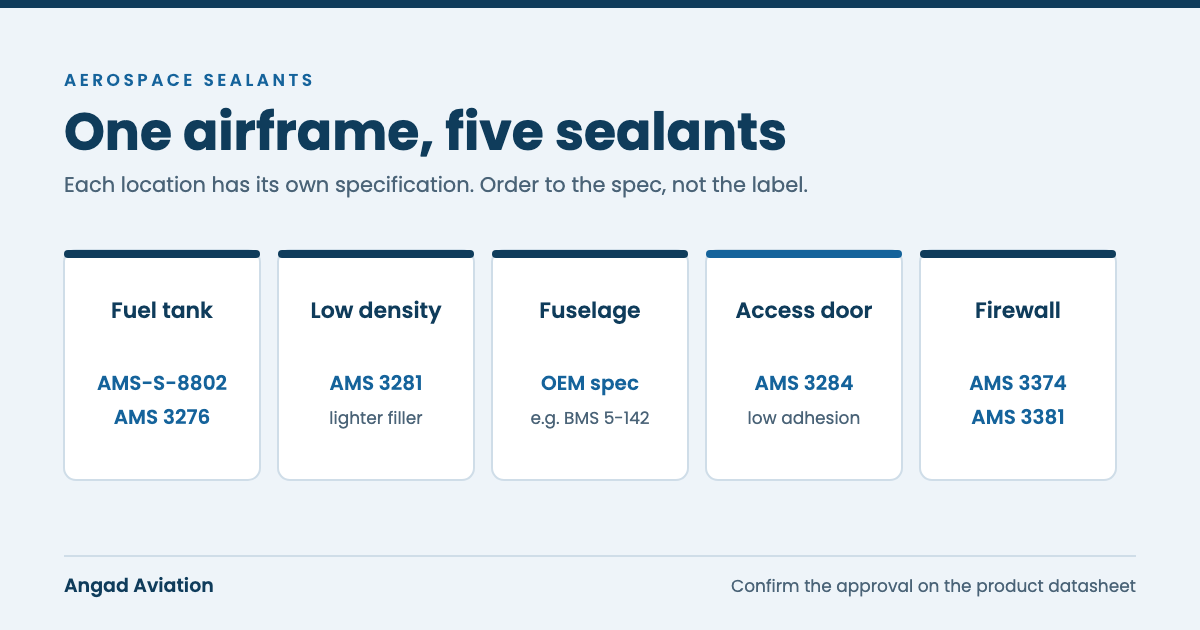
Aerospace sealants are chosen by where they go, and each location has its own specification:
| Application | What it has to do | Specification to look for |
|---|---|---|
| Integral fuel tank, standard density | Seal permanently under continuous fuel immersion | AMS-S-8802, AMS 3276 |
| Integral fuel tank, low density | The same job, lighter | AMS 3281 |
| Fuselage and pressure joints | Seal the airframe; limited fuel contact | Often an OEM spec (e.g. Boeing BMS 5-142) |
| Access doors and removable panels | Seal, then let go when the panel is removed | AMS 3284 (formerly MIL-S-8784) |
| Firewalls | Hold a seal through a fire | AMS 3374 (silicone), AMS 3381 (non-silicone) |
The specification is what your maintenance data calls for. The brand and product are what satisfies it. Order to the spec, then confirm the product is qualified to it on the manufacturer's datasheet.
Fuel tank sealants — AMS-S-8802 and AMS 3276
Integral fuel tank sealants are polysulfide compounds made to stay sealed while permanently wetted by fuel. The two specifications you will see most are AMS-S-8802 (the successor to MIL-S-8802) and AMS 3276, which covers fuel-resistant polysulfide for integral fuel tanks and general-purpose airframe use.
AMS-S-8802 is also where the familiar suffix comes from:
- Class A is brushable.
- Class B is applied with an extrusion gun or spatula, for fillets and fastener seals.
- Class C is spread on faying surfaces, by roller or comb spreader.
- The dash number is the application time in hours.
B-2gives you two hours to work;A-1/2gives you half an hour.
So PR-1782 B-2 and PR-1782 A1-2 are the same chemistry: one extruded with two hours to work, one brushed with a shorter window. Confirm the exact application life on the datasheet. PPG PR-1750 is an AMS 3276 fuel tank sealant with a cured specific gravity of about 1.57 per PPG's datasheet — a standard-density material.
Low-density fuel tank sealants — AMS 3281
A fuel tank holds a great deal of sealant, so weight matters. Low-density grades do the same job with a lighter filler. The specification is AMS 3281 (low-density polysulfide for integral fuel tanks and fuel cell cavities).
Real examples:
- PPG PR-1782 — cured specific gravity
about 1.11 per PPG's datasheet, which PPG puts at up to 30% lighter. Its datasheet tests it to Airbus AIMS specifications, so check the approval your data calls for. PR-1782S is the sprayable variant.
- PPG PR-1776M — described by PPG as a low-density,
high-temperature fuel tank sealant.
low-density polysulfide sold for both fuel tanks and fuselage.
"Low density" is a property, not an approval. A low-density sealant still has to be qualified to the spec in your maintenance data before it replaces a standard-density one.
Fuselage sealants
Not every seam is in a fuel tank. Pressurised fuselage joints, fairings and floors need a sealant that handles moisture, pressure cycling and the occasional splash, without the cost and weight of a full fuel-immersion grade.
PPG PR-1772 is a good example. PPG sells it as a low-weight fuselage sealant (cured specific gravity about 1.09) to Boeing BMS 5-142, rated for _limited_ fuel exposure. It is not a fuel tank sealant. Its sibling PR-1429 is a floorboard sealant for butt-sealing between floor panels.
The lesson: a "fuselage sealant" in a search result may or may not be fuel-rated. Read the exposure rating before using one near a tank boundary.
Access-door and low-adhesion sealants — AMS 3284
A fuel tank access panel has to seal, and then come off again at the next inspection without tearing the structure or the panel. That needs a low-adhesion sealant: one that seals well but releases cleanly. The specification is AMS 3284, which superseded MIL-S-8784.
Examples in this family:
- PPG PR-1428 — a low-adhesion access-door sealant
to MIL-S-8784.
- PPG PR-1773 — low-adhesion, non-chromate and
corrosion-inhibitive, to AMS 3284 Class B.
- H.B. Fuller WS-8010 — a low-adhesion access-door
sealant.
- Flamemaster CS 3330 and Chemetall Naftoseal MC-216M are also low-adhesion sealants for
removable panels.
Never substitute a standard fuel tank sealant here. It will seal, and the next person to open that panel will pay for it.
Firewall sealants — AMS 3374 and AMS 3381
Firewall sealants have to keep sealing through a fire. There are two specification families, split by chemistry:
- AMS 3374 covers silicone firewall sealants.
Solvay DAPCO 2200 is a two-part, primerless silicone firewall sealant qualified to AMS 3374, among others.
- AMS 3381 covers non-silicone firewall sealants.
PPG PR-812 is a two-part, primerless synthetic-rubber (not silicone) firewall sealant tested to AMS 3381.
Flamemaster CS 1900 is a third case worth knowing: a non-silicone firewall sealant sold to MIL-S-38249 Type 1, whose own datasheet says it is not yet qualified to AMS 3381. That is exactly why you check the datasheet against the spec you need, not just the word "firewall" on the label.
What to send with an order
- The specification and class, e.g. "AMS 3284 Class B" or "AMS-S-8802 B-2".
- The approved product, if your maintenance data names one.
- The kit form — cartridge, can or pre-mixed frozen — and the quantity per kit.
- The remaining shelf life you need on arrival. Two-part sealants have a limited shelf life,
and frozen pre-mixed kits also depend on an unbroken cold chain.
- Batch documentation. For a shelf-life-limited material, the batch and its dates are what the
paperwork is for.
Frequently asked
What is a low-density sealant?
A fuel tank sealant made with a lighter filler, so the same seal weighs less. The specification is AMS 3281. Low density describes the material; it does not by itself approve a substitution.
Can I use fuel tank sealant on an access door?
No. An access door needs a low-adhesion sealant to AMS 3284 so the panel can be removed. A standard fuel tank sealant bonds too strongly.
What is the difference between AMS 3374 and AMS 3381?
Both are firewall sealant specifications. AMS 3374 covers silicone firewall sealants; AMS 3381 covers non-silicone ones.
What does B-2 mean on a sealant?
Under the AMS-S-8802 convention, B is the class (extrudable, for fillets) and 2 is the application time in hours. Confirm both on the product datasheet.
Sourcing aerospace sealants? Angad Aviation sources fuel tank, low-density, fuselage, access-door and firewall sealants from PPG, Chemetall, H.B. Fuller, Solvay, Flamemaster and others, with batch documentation and traceability. Browse sealants, or send us the specification and class and we will quote it.