
Aircraft vibration isolators: how to choose a mount for avionics, equipment and engines
The short answer
A vibration isolator is a flexible mount, usually an elastomer bonded to metal, that sits between a piece of equipment and the structure it is fixed to. It reduces how much vibration and shock passes between them.
It is chosen on five things:
- Load per mount: the weight it carries, divided by the number of mounts.
- The frequencies you need to isolate: a mount only isolates vibration well above its own
natural frequency.
- Shock: occasional bumps, or severe, repeated shock.
- Temperature: the elastomer must keep its properties across the range the location sees.
- Space: low-profile and miniature mounts exist because height is often the constraint.
How an isolator works, and when it makes things worse
Any mounted item has a natural frequency, set by its mass and the stiffness of its mounts. What reaches the equipment depends on the ratio between the disturbing frequency and that natural frequency:
- Near the natural frequency, the mount amplifies vibration. This is resonance.
- At about 1.4 times the natural frequency (√2), output equals input. This is the crossover.
- Above that, the mount isolates, and isolation improves as the ratio grows.
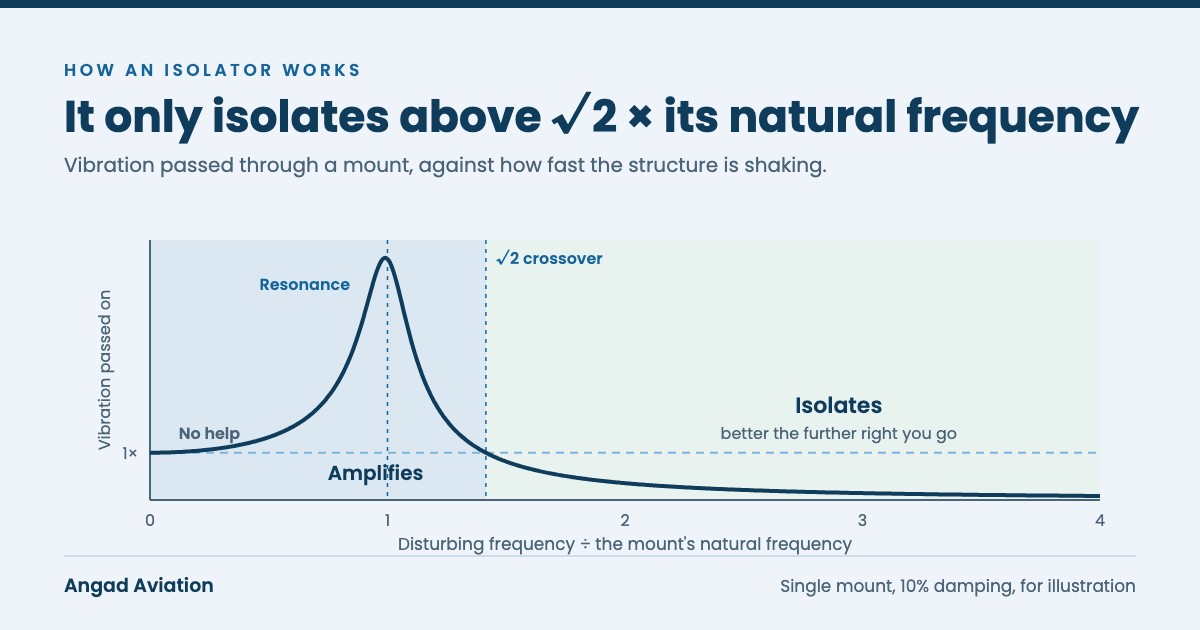
So a soft mount with a low natural frequency isolates more of the spectrum. But a mount that is too soft sags under load and moves too far under shock. Damping in the elastomer limits the peak at resonance, at the cost of slightly poorer isolation at high frequencies. Every mount is a balance of those three.
This is why mount data is quoted as a natural frequency at rated load. Parker's part pages for some LORD Plateform mounts (for example 100APLQ-5) give a system natural frequency of about 10 Hz at rated load, with effective isolation where the disturbing frequencies are above 20 Hz. The 150APLW-4 Plateform mount is quoted at about 18 Hz, isolating from 40 Hz. The figures differ part to part, so read them from the datasheet for the exact part number, at the load you will actually put on it.
Which mount for which job
Parker LORD's aerospace mounts split into families by the job they do:
| Mount family | Built for | Watch for |
|---|---|---|
| Plateform | Light equipment and accessories; steady-state vibration and occasional shock | Natural frequency differs by part number |
| Multiplane | Light equipment where vibration acts in any direction | Parker does not recommend it where severe, frequently recurring shock is present |
| Low-profile avionics (AM series) | Avionics, inertial navigation, radar, where mounting height is limited | Choose the elastomer (BTR or BTR II) for the temperature range |
| Pedestal | Heavier avionics and electronic boxes | Shock-rated; check the load table for your part |
| High-deflection | High-energy shock that needs long travel | Needs the clearance for that travel |
| Miniature (MCB, MGN/MGS) and Micro-Mount | Circuit boards, sensors, displays, small instruments | Sized for very light loads |
| Engine mounts (Dynafocal) | Piston engines in general aviation | Specific to the airframe and engine; ordered by the part number in the parts catalogue |
Low-profile avionics mounts
Parker describes the AM series as compact, high-load isolators made of specially compounded silicone elastomer, to support and protect avionics in all types of aircraft. There are two elastomer options:
- BTR silicone, rated from -65 °F to +300 °F (-54 °C to +149 °C).
- BTR II silicone, rated from -40 °F to +300 °F (-40 °C to +149 °C).
Parker states they are tested and approved to the environmental tests in MIL-STD-810 or the older MIL-E-5400.
Pedestal mounts
Pedestal mounts are bonded in Parker's BTR elastomer and rated from -65 °F to +300 °F. LORD's datasheet rates them to take a 15 g, 11 ms half-sine shock pulse without significant change in performance, and a 30 g, 11 ms half-sine pulse without failure.
Engine mounts and the Dynafocal design
On a piston aircraft, the engine mounts carry the whole engine and propeller and isolate their vibration from the airframe. Parker says LORD supplied the first Dynafocal® engine mounts for aircraft, more than 70 years ago.
In a Dynafocal installation the isolators are set at an angle rather than square to the firewall. Their lines of action meet at a focal point near the centre of gravity of the engine and propeller, which is where the name comes from. There is more than one Dynafocal geometry: most Lycoming installations are Dynafocal 1, and the rarer Dynafocal 2 was used almost exclusively on Piper's Twin Comanche. A mount for one does not fit the other.
A typical installation uses four or six mounting assemblies. Each is two bonded rubber-and-metal sandwich mountings and a spacer, and the spacer is specific to the installation.
When to replace an engine mount
Parker LORD's guidance says that for type-certificated aircraft the approved component maintenance manual governs all maintenance actions; follow it and your regulator's requirements. The same guidance is a useful picture of what to look for.
Parker LORD's guidance is to inspect the installed mounts, carrying the engine's weight, at each annual inspection and every FAA-required engine inspection. Look for:
- the elastomer separating from the metal
- elastomer that is noticeably soft, gummy, stiff or hardened
- cracks, cuts or gouges
- drift, where the mount has drift indicators
- excessive sag
Replace the mount assembly if the elastomer is:
- very soft, swollen or gummy (usually from fluid exposure)
- cracked, other than ozone cracking
- separated from the metal plates
- ozone-cracked deeper than 0.020 in
Shallow ozone cracks in a grid pattern do not need replacement on their own. They can grow into flex cracks, so a reinstalled mount with known ozone damage must be monitored. Parker also lists dimensional limits per mount series in its guidance.
Three cautions from the same guidance:
- Keep solvents and engine oils off the rubber. Cover the mounts when you clean the engine,
and never put a bonded component in cleaning solvent.
- Don't pry a mount out. Prying tools can cut the elastomer or dent the metal.
- Take the engine's weight off before removing mounts. Parker says to use a chain hoist or
equivalent, and to remove a single mount under load only if necessary, because that easily damages it.
Shimmy dampers: the same rubber, a different job
A shimmy damper stops the rapid side-to-side vibration of a nose wheel on the ground. Parker LORD's fluid-free shimmy damper uses a fluid-free surface-effect design (a specialised rubber compound working against a lubricant) instead of hydraulic fluid, so there is nothing to leak.
LORD reports targeted damping maintained beyond 5,000 ground-air-ground cycles in accelerated life testing, and rates the damper from -30 °F to +150 °F. Parker LORD's general-aviation brochure lists SE-1051-2 for many Cessna 150, 152 and 172 models. As with engine mounts, confirm the part number for your aircraft against the parts catalogue.
Frequently asked questions
What does a vibration isolator do?
It sits between equipment and structure and reduces the vibration and shock passing between them. It does this only for vibration well above its own natural frequency.
Why can an isolator make vibration worse?
Near the mount's natural frequency, it amplifies vibration instead of reducing it. Isolation starts only above about 1.4 times the natural frequency.
What is a Dynafocal engine mount?
An engine mount whose isolators are angled so their lines of action meet near the engine and propeller's centre of gravity. Parker says LORD supplied the first Dynafocal mounts for aircraft.
What is the difference between BTR and BTR II silicone?
They are Parker LORD's broad-temperature-range elastomers. Parker rates BTR from -65 °F to +300 °F, and BTR II from -40 °F to +300 °F.
How do I know when an engine mount needs replacing?
Follow the aircraft's approved maintenance manual. Parker LORD's general-aviation guidance is to inspect the mounts at each annual and engine inspection, and to replace them if the elastomer is very soft, swollen or gummy, separated from the metal, cracked (other than ozone cracking), or ozone-cracked deeper than 0.020 in.
Sourcing vibration isolators? Angad Aviation sources Parker LORD plateform, multiplane, pedestal, avionics and engine mounts and shimmy dampers with full traceability. Browse vibration mounts and isolators, or send us the part number and we will quote it.