
FAA Form 8130-3 explained: every block, the status codes and dual release
The short answer
FAA Form 8130-3, the _Authorized Release Certificate_ or _Airworthiness Approval Tag_, is the document that travels with an aircraft part to show it may be installed.
It has two uses, and only one is ever filled in on a single form:
- A production release (block 13), for a new part made under FAA production approval. FAA
Order 8130.21J (September 2025) gives the instructions.
- A maintenance release (block 14), for a part returned to service after repair, overhaul,
inspection or modification. Since September 2025 those instructions are in Advisory Circular AC 43-9D, not the order.
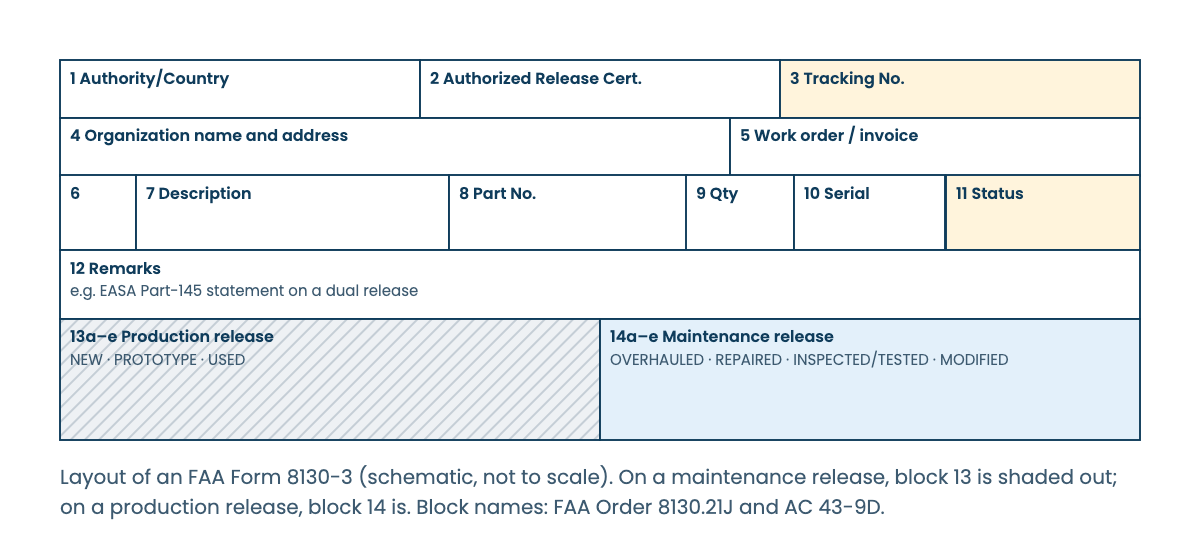
The unused side is shaded out, and a production release and a maintenance release cannot be mixed on one form.
What each block means
| Block | Name | What goes in it |
|---|---|---|
| 1 | Approving Civil Aviation Authority/Country | The FAA / United States |
| 2 | Authorized Release Certificate | The form's title |
| 3 | Form Tracking Number | A number the issuer sets for this form |
| 4 | Organization Name and Address | Who issued the release |
| 5 | Work Order/Contract/Invoice Number | The customer's work order, contract or invoice number, or N/A |
| 6 | Item | Item number (N/A on a maintenance release) |
| 7 | Description | The part's name |
| 8 | Part Number | The part number |
| 9 | Quantity | How many |
| 10 | Serial Number | The serial number, or "N/A" |
| 11 | Status/Work | What the part is, or what was done to it (see below) |
| 12 | Remarks | Anything the release needs to say: the standard used, dual-release wording |
| 13a–e | Production release | Approval box, signature, approval number, name, date |
| 14a–e | Maintenance release (return to service) | Return-to-service boxes, signature, certificate number, name, date |
Two details buyers often miss:
- Block 14e is the date the work was completed, not the date the part was shipped.
- A corrected form gets a new tracking number in block 3, and refers back to the form it
corrects.
The block 11 status codes
Block 11 tells you what you are buying.
On a production release (block 13):
- NEW: a new part that conforms to approved design data.
- PROTOTYPE: a new part that conforms to design data not yet approved.
- USED: a used part being exported.
On a maintenance release (block 14):
- OVERHAULED: taken apart, cleaned, inspected, repaired as needed, reassembled and tested to
the approved data.
- REPAIRED
- INSPECTED and/or TESTED
- MODIFIED
On a maintenance release, the standard the work was done to is described in block 12.
Dual release: one form for the FAA and EASA
A dual release is a single 8130-3 that returns a part to service under both the FAA and EASA. On it, the repair station:
- ticks both boxes in block 14a: "14 CFR 43.9 Return to Service" and "Other regulation
specified in Block 12";
- writes an EASA Part-145 release statement in block 12, ending with its EASA Part-145 approval
number;
- puts its FAA certificate number in block 14c.
Only a facility that holds both FAA and EASA approval, and is located in the United States or an EU Member State, can issue one. Anyone else must issue an FAA Form 8130-3 and an EASA Form 1 as two separate certificates. Because a dual release is one form, it has one tracking number.
The form can carry a dual release with one other authority, not several. Under the EU-US agreement's maintenance guidance (MAG), EASA accepts maintenance from US repair stations that also hold EASA Part-145 approval, normally on a dual-release 8130-3. The MAG covers a few special cases.
New parts are different. Under the EU-US Technical Implementation Procedures, an 8130-3 production release from a US manufacturer holding FAA production approval is accepted for a new part. Standard parts are accepted with the manufacturer's certificate of conformity.
What about China (CAAC)?
The FAA lists two agreements with the CAAC: the bilateral agreement (BASA) and its Implementation Procedures for Airworthiness. Those procedures cover new parts. Each authority accepts the other's release certificate, the FAA Form 8130-3 or CAAC Form AAC-038, for parts that conform to approved design.
The FAA lists no maintenance agreement with the CAAC. Before relying on an 8130-3 for a repaired part in China, check with your CAAC-approved maintenance organisation.
Does every part need an 8130-3?
No.
- A manufacturer issues an 8130-3 for new parts only if it chooses to. US rules (14 CFR 21.9)
allow other routes, including standard parts and commercial parts.
- For a maintenance release, AC 43-9D calls the form recommended. What the regulations require
is the content of the maintenance record.
- An 8130-3 is not a shipping document, and it cannot release a whole aircraft.
This is why purchase orders often ask for "EASA Form 1 and/or FAA 8130-3 where applicable". Agree which document you need before you order. Our post on certificate of conformance vs EASA Form 1 vs FAA 8130-3 explains when a CoC is enough.
Electronic 8130-3s
The FAA allows the form to be filled out and signed electronically. For maintenance releases, AC 43-9D also allows the data to be kept in a secure database rather than as an image. When printed, it should still be presented as the standard form, so it is recognised and accepted.
On a production release, the manufacturer may add security features such as QR codes or barcodes in block 12. They cannot replace any entry the form requires.
Frequently asked
What is the difference between block 13 and block 14 on an 8130-3?
Block 13 is a production release for a new part. Block 14 is a maintenance release, returning a part to service after repair, overhaul, inspection or modification. Only one is used on a form; the other is shaded out.
What does "Other regulation specified in Block 12" mean?
It means the part is also released under another authority's rules, which block 12 names. With the FAA box also ticked, it is a dual release, usually FAA and EASA.
Can one 8130-3 be valid for both the FAA and EASA?
Yes, as a dual release, issued by a facility holding both FAA and EASA approval in the US or an EU Member State. It is one form with one tracking number.
Is EASA Form 1 the same as FAA Form 8130-3?
They do the same job for two different authorities. We compare them in EASA Form 1 vs FAA 8130-3.
Which document replaced FAA Order 8130.21H?
Order 8130.21J (September 2025) now covers production releases. Maintenance releases moved to Advisory Circular AC 43-9D.
Need a part with the right release certificate? Angad Aviation supplies traceable parts. When a part arrives with an EASA Form 1 or FAA Form 8130-3, we seal a copy so you can check online that your copy is unchanged. Send us the part number and the document you need, and we will quote.