
Retaining compounds vs threadlockers: choosing an anaerobic for aviation
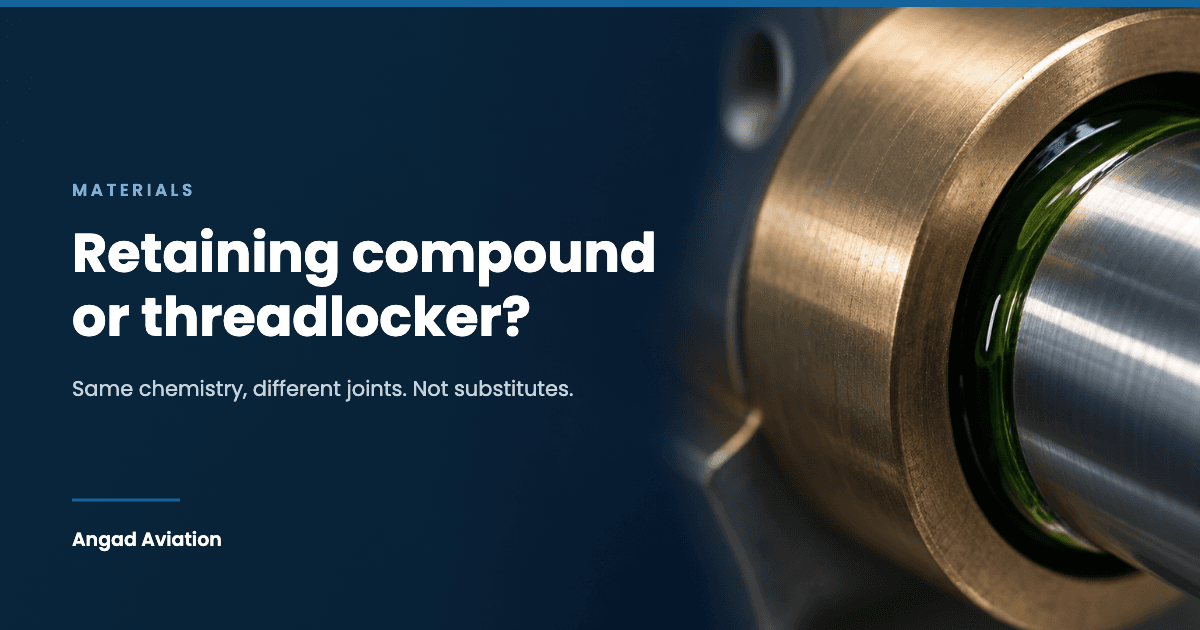
The short answer
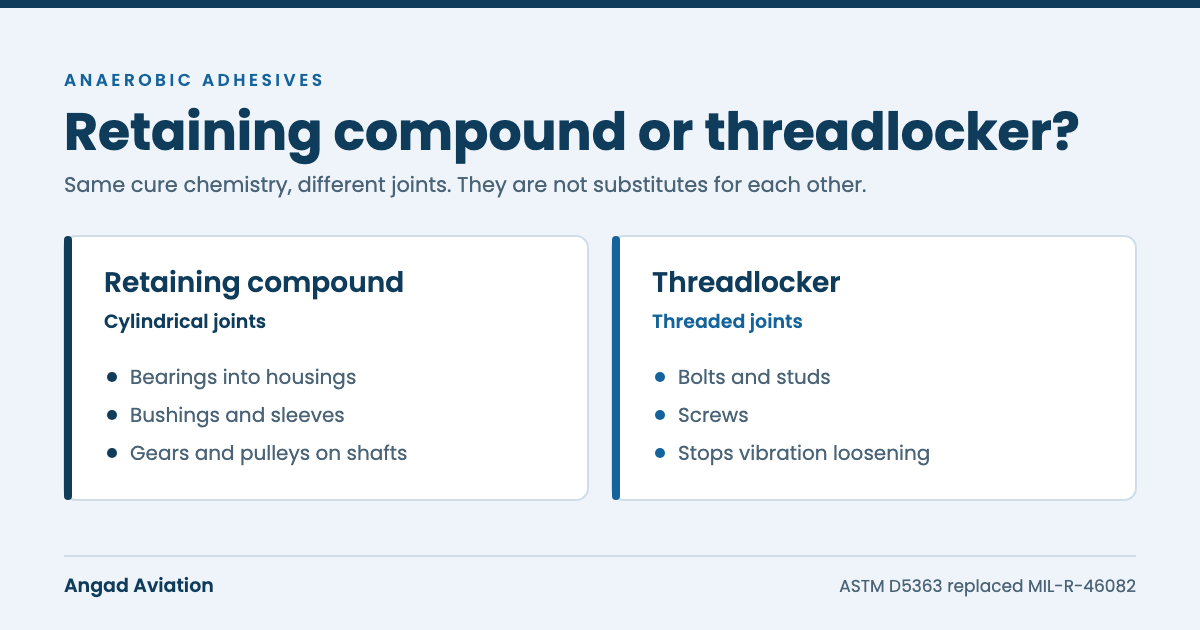
A retaining compound bonds cylindrical parts: a bearing into a housing, a bushing, a sleeve, a gear or pulley onto a shaft. A threadlocker secures threaded fasteners against loosening. Both are anaerobic adhesives, but they are formulated for different gaps, loads and strengths, and you should not substitute one for the other.
How anaerobics cure
Anaerobic adhesives stay liquid in the bottle, where air is present. Henkel describes its retaining compounds as curing "when confined in the absence of air between close fitting metal surfaces", with active metal ions such as iron or copper driving the cure.
That has three practical consequences:
- The fit matters. Retaining compounds are made for close fits. Each grade has a gap it can
fill, and beyond that it will not cure reliably.
- The metal matters. "Passive" surfaces such as stainless steel, plated finishes or anodised
aluminium cure more slowly. Some grades are designed for them; others need an activator.
- Cleanliness matters. Oil and contamination affect the bond. Some grades tolerate it better
than others.
How the grades differ
Retaining compounds differ in four ways: strength, gap fill (viscosity), temperature and tolerance of oil or passive metals. Henkel's Loctite range shows the spread. What follows paraphrases the Henkel technical data sheets; confirm the figures on the current TDS before you specify.
| Grade | Strength | What distinguishes it |
|---|---|---|
| LOCTITE 603 | High | Low viscosity, for use where consistently clean surfaces cannot be assured; roller bearings, oil-impregnated bushings |
| LOCTITE 609 | High | Low-viscosity, general-purpose grade for close fits (Henkel gives a maximum gap of about 0.15 mm) |
| LOCTITE 620 | Medium to high | High-temperature assemblies; gaps approaching 0.2 mm |
| LOCTITE 638 | High | Gaps approaching 0.25 mm; works on passive metals; oil tolerant |
| LOCTITE 641 | Medium | For assemblies that must be taken apart for service, such as bearings on shafts and in housings |
| LOCTITE 648 | High | Low viscosity, gaps approaching 0.15 mm; high temperature; oil tolerant; works on passive metals |
Read the table against your job, not for a "best" grade:
- Will this part come apart again? A medium-strength grade such as 641 is chosen _because_ it
lets the bearing be removed. A high-strength grade can make that difficult without heat.
- How big is the gap? A worn or looser fit needs a higher-viscosity, gap-filling grade.
- What temperature will it see? Engine-adjacent parts need a high-temperature grade.
- Is the surface clean and active? If not, choose a grade made for oil or passive metals, or
use the activator the TDS specifies.
The specification — MIL-R-46082 and ASTM D5363
Older drawings and maintenance data call retaining compounds out to MIL-R-46082. That specification has been superseded by ASTM D5363, which also replaced the anaerobic threadlocker and sealant specs MIL-S-22473 and MIL-S-46163. You will still see both references on a single datasheet: the LOCTITE 609 TDS, for example, lists both "Mil-R-46082B" and "ASTM D5363".
When an old document names a MIL-R-46082 grade, the modern order is the ASTM D5363 equivalent, or the specific product your approved data names.
Retaining compound or threadlocker?
| Retaining compound | Threadlocker | |
|---|---|---|
| Joint | Cylindrical, e.g. bearing, bushing, sleeve, shaft | Threaded, e.g. bolt, stud, screw |
| Job | Carry load across the fit, fill the gap, prevent fretting | Stop vibration loosening, seal the thread |
| Removal | Often needs heat at high strength | Low and medium grades come off with hand tools |
Where your maintenance data names a product, use that product. These are general properties, not approvals.
Frequently asked
What is a retaining compound used for in aviation?
Bonding cylindrical assemblies such as bearings into housings, bushings, sleeves and shaft-mounted parts. It fills the gap between the parts, carries load and prevents fretting.
Can I use a threadlocker instead of a retaining compound?
No. They are formulated for different joints, gaps and strengths. Use the grade your data calls for.
Which specification replaced MIL-R-46082?
ASTM D5363, which also replaced MIL-S-22473 and MIL-S-46163.
Why won't my anaerobic cure?
Usually the gap is too large for the grade, the surface is passive (stainless, plated or anodised), or the parts were contaminated. The TDS will say whether an activator is needed.
Sourcing retaining compounds or threadlockers? Angad Aviation sources the Henkel LOCTITE range and other anaerobic adhesives with batch documentation and traceability. Browse adhesives, or send us the grade or specification and we will quote it.