
Chip detectors explained: magnetic, electric and Eaton Tedeco Zapper
The short answer
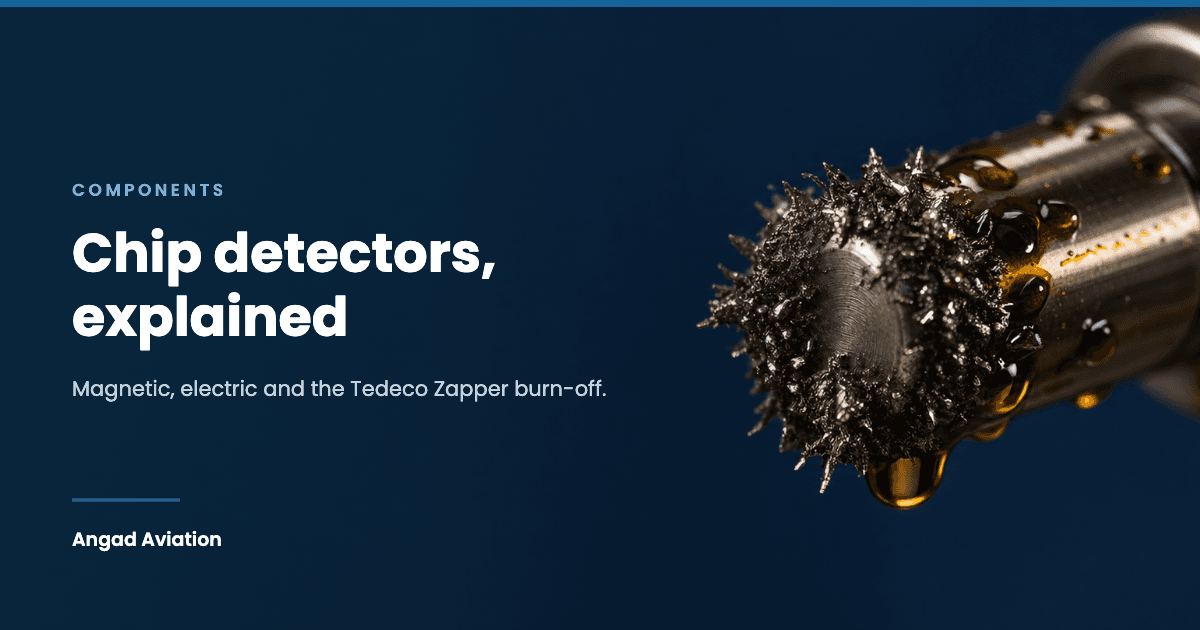
A chip detector is a magnetic probe in an engine or gearbox oil system that captures ferrous wear particles. Metal in the oil is often the first sign that a bearing or gear is starting to fail.
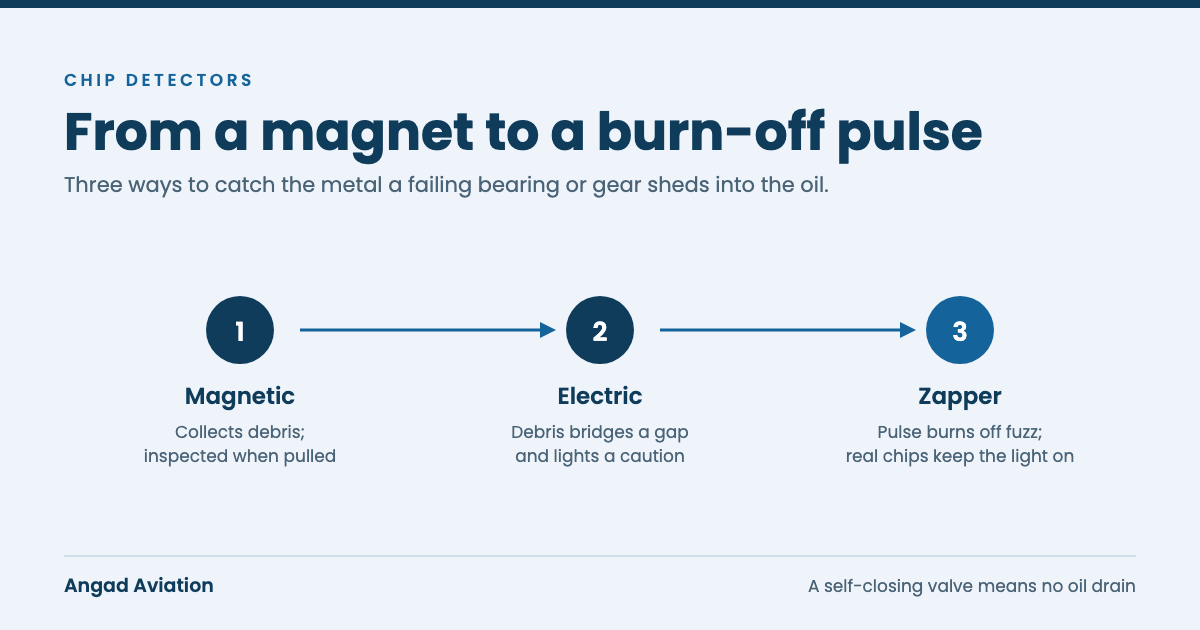
- A magnetic chip detector collects the particles for inspection when the probe is pulled.
- An electric chip detector also gives a signal: debris bridging an electrical gap completes a
circuit and lights an indicator.
- A pulsed ("Zapper") chip detector, such as Eaton's Tedeco Zapper, burns off small, normal
wear debris so that only significant debris keeps the warning on.
Magnetic chip detectors
The simplest form is a magnetic plug in the oil flow. Ferrous particles circulating in the oil stick to it, and the maintainer removes and inspects it at a set interval. What is found, and how much, is read against the maintenance manual's limits.
Its strength is simplicity. Its limit is that it only tells you something when someone looks.
Electric chip detectors
An electric chip detector adds a signal. The magnetic probe has an insulated gap. When enough ferrous debris collects to bridge that gap, it completes a circuit and gives an indication, typically a cockpit caution. Eaton describes its electric chip detectors as capturing _and indicating_ the ferrous particles that show wear or potential impending failure of rotating components.
The drawback is nuisance indications. Normal wear produces fine "fuzz", and fuzz can bridge the gap as easily as a real chip. Every indication has to be investigated, and on a helicopter that can mean a precautionary landing.
The Eaton Tedeco Zapper: burning off the fuzz
The Zapper is Eaton's answer to nuisance indications. Per Eaton's own description:
- A capacitor circuit discharges a low-energy pulse through the debris bridge, about
0.05 joules. That heats the gap enough to open it, much like blowing a fuse.
- If the pulse clears the bridge, the "burn-off" event is recorded and the detector returns to
monitoring.
- If the debris is too large to burn off, it is treated as significant and the cockpit light
stays on.
So the crew still sees real debris, and stops seeing fine wear debris. Eaton also offers a microprocessor-based evolution, the Smart Zapper, and an FAA-STC'd pulsed electric chip detector system for specific helicopter and engine combinations.
Why the self-closing valve matters
Pulling a chip detector would mean draining the oil system if the hole simply stayed open. Eaton's detectors sit in a self-closing valve: as the probe is withdrawn, the valve closes, so the detector can be removed for inspection with minimal oil loss and no drain. The probe engages the valve through a bayonet or threaded interface, and O-rings seal it with the probe both in and out.
When you order, the probe and the valve are separate items. Make sure they match each other and the installation.
What to send with an order
- The part number from your maintenance data for the detector _and_ its valve or adapter.
- Magnetic, electric or pulsed, and for electric types the connector and indicating system.
- Any STC the installation depends on, since pulsed systems are often tied to a specific
airframe and engine.
- The release documentation you require for the installation.
The rest of the Tedeco range
Eaton's Tedeco line also covers the rest of the oil-system monitoring kit around the chip detector: sight gauges and sight plugs, snap-cap oil fillers, LevelPro liquid-level sensors and breathers.
Frequently asked
What does a chip detector do?
It captures ferrous wear particles from engine or gearbox oil, so wear can be caught before a bearing or gear fails. Electric types also give a cockpit indication.
What is a Zapper chip detector?
An Eaton Tedeco electric chip detector that sends a low-energy pulse through the debris bridging its gap. Small wear debris is burned off; debris too large to burn off keeps the warning on.
Can a chip detector be removed without draining the oil?
Yes, when it is fitted in a self-closing valve. The valve closes as the probe is withdrawn.
Is a chip light always a failure?
No, which is why burn-off systems exist. But a chip indication is always investigated against the maintenance manual.
Sourcing chip detectors or Tedeco parts? Angad Aviation sources Eaton Tedeco chip detectors, Zapper systems, self-closing valves and oil-system monitoring parts with full traceability. Browse fluid monitoring and indicators, or send us the part number and we will quote it.